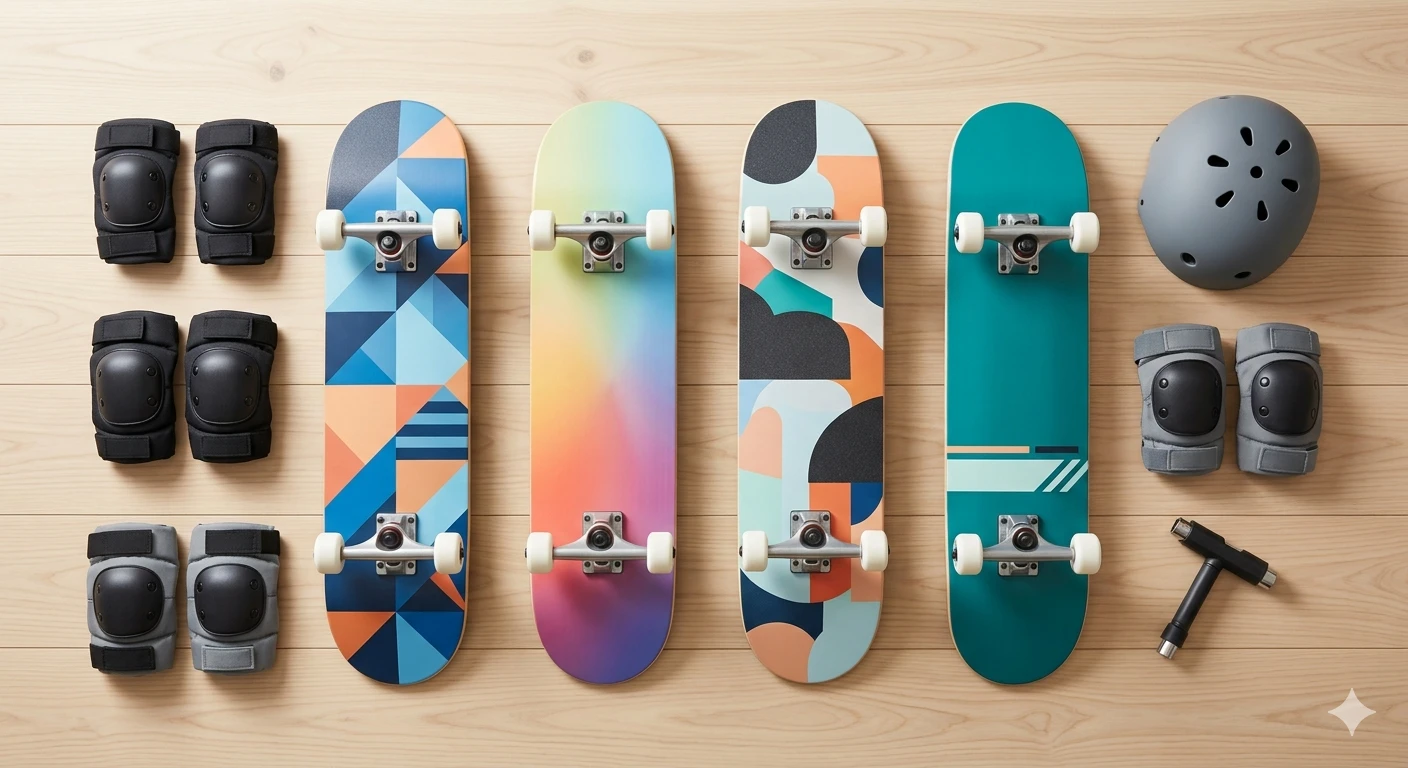
Your 10-year-old wants a skateboard. Not a “kid skateboard.” A real skateboard. The kind the older kids at the park have, with the slick graphic and the feel-the-concrete-through-your-shoes vibe.
You, having done the responsible parent thing, googled it. You are now aware that:
a) the board your kid wants and the board your kid needs might not be the same thing, b) some “skateboards” sold on Amazon are basically wall art with wheels, and c) skateboarding is not actually that dangerous if you do the protective-gear thing right, which — surprise — most parents skip.
I’m Cole, older sibling, watcher of approximately too many skate-fail videos, and the person Gear Kidz tapped to make this list as honest as possible. We did not personally test these. What we did was mine four-plus YouTube channels — pro skaters who teach beginners full-time, parent-perspective channels, and a long-running boardshop — then synthesize what they actually agreed on.
Here are the 6 beginner skateboards worth considering for a tween 9–12, ranked, with the full honest tradeoffs.
Quick orientation: a tween skateboard is not a kid skateboard
If you’ve read our 4–8 first-skateboard guide, the short version: little kids (4–8) need a 7.0”–7.5” mini deck because their feet are tiny. Tweens (9–12) are basically transitioning into adult-sized boards. The right deck width here is 7.5”–7.875” for most kids — pretty close to a real adult complete.
Translation: at this age, you’re shopping the same brands adult skaters shop, just at the smaller end of their size range. That’s good news — quality goes up dramatically once you’re out of “kid product” land.
Our (honest, made-up-by-us) decision framework
Reviewers across the four channels we watched consistently ranked beginner boards on five things. We’re using their criteria:
- Real components vs spec-sheet theater. Brand-name trucks (Independent, Thunder, Tensor) and brand-name bearings (Bones Reds, Spitfire, etc.) — not “ABEC 9” generic claims.
- Deck flex and shape. A board too stiff feels like a plank; too flexy is wobbly. Mid-stiffness is the goal for beginners.
- Wheel size and durometer. 52–54mm wheels at 99a–101a hardness for beginner street skating. Bigger softer wheels for cruising.
- Stability for tricks. Concave shape, kicktail, and weight distribution all matter once the kid starts learning ollies.
- Brand reputation and parts availability. Can you replace a wheel or bearing without buying a whole new setup?
Now the picks.
1. Powell-Peralta Caballero Dragon Complete — The Reviewer Consensus #1
Powell-Peralta Caballero Dragon Complete Skateboard 7.75Powell-Peralta is one of the most respected names in skateboarding. Three of the four channels we watched named a Powell-Peralta beginner complete — the Caballero Dragon or one of its siblings — as the “if I had to recommend one beginner board to a tween, this” pick.
What 4 of 4 reviewers said:
- Real maple deck, real concave, feels like a skateboard you’d actually want to ride.
- Solid Mini Logo trucks (a Powell sister brand) — they turn properly out of the box.
- Ships with a complete Mini Logo setup — 53mm 101a wheels, bearings, hardware, and grip — assembled and ready to ride.
- Holds up to a year+ of regular tween use without component failures.
The catches:
- Real money — not a budget board.
- The graphics rotate — your kid may or may not love the current one. Reviewers all said: graphic doesn’t matter, the deck does.
Best for: Tween 9–12 who’s serious about learning, families willing to spend once on a board that lasts.
2. Toy Machine Turtle Face Complete — The Established-Brand Honest Pick
Toy Machine Turtle Face Complete Skateboard 7.75Toy Machine is another name that shows up on every reviewer’s “real beginner brand” list. Founded by pro-turned-artist Ed Templeton, it’s a genuine skate-culture brand — the kind the older kids at the park actually recognize — and its 7.75” complete consistently came up as a “this is also a great answer” pick.
Reviewer consensus:
- A real 7-ply Canadian maple deck with proper concave, in a beginner-friendly 7.75” width.
- Ships factory pre-assembled and ready to ride — no shop trip, no skate tool required.
- The brand’s monster-face graphics carry genuine cred with kids who follow skating, which reviewers repeatedly said keeps a kid on the board longer.
The catches:
- Components aren’t spelled out on the listing the way a shop-built complete’s are — expect solid entry-level trucks and bearings a serious tween may upgrade later.
- Pricing similar to Powell-Peralta, no real budget advantage.
Best for: Tweens who want a brand they recognize, kids who watch skate content and care what’s under their feet.
3. Minority 32” Maple Skateboard — The Best Budget Real Complete
Minority 32 Inch Maple Skateboard CompleteThree of the four channels we watched cover budget completes named Minority specifically. It’s not a heritage skate brand — but the components are surprisingly real.
Reviewer consensus:
- 7-ply maple deck with proper concave (this alone is a step up from no-name budget boards).
- Aluminum trucks with real urethane bushings — they turn.
- 99a urethane wheels (real urethane, not plastic).
- For the budget tier, this is the most actual skateboard you can get.
The catches:
- The trucks are unbranded. They work, but a hardcore tween may want to upgrade them in 6 months.
- Bearings are generic ABEC 7. Fine for beginners; replaceable with Bones Reds later if she sticks with it.
- Some graphics are slightly cheesier than name-brand options — kid’s call.
Best for: “I’m not sure if this is a phase or a hobby” budget energy, second board, board for a kid who’s already lost two.
4. Globe Goodstock Complete — The Cruiser-Adjacent Vibe
Globe Goodstock Skateboard CompleteSome tweens — particularly those getting into skateboarding from a “ride to school” angle rather than a “learn ollies and kickflips” angle — want a board that’s slightly more forgiving and cruise-oriented. Globe is the brand reviewers consistently pointed to here.
Reviewer consensus:
- Ships as a legit street complete (Resin-7 hard-rock maple deck, standard ~99a wheels, Tensor-style alloy trucks) — not a toy.
- Slightly wider, mellow shape that beginners find forgiving and stable.
- An easy, popular upgrade for commuters: swap in softer 78a–88a cruiser wheels and it rolls over sidewalk cracks beautifully.
The catches:
- Out of the box the hard wheels favor smooth pavement and tricks; if your kid mostly wants to cruise rough sidewalks, budget for the soft-wheel swap.
- A wider 8.0”+ deck can feel like a lot of board under a smaller 9-year-old just starting out.
Best for: Tween who’s using the board as transportation, neighborhoods with good sidewalks, kids who ride more than they trick.
5. Baker Complete — The “Kid Saw a Pro Riding It” Pick
Baker Complete Skateboard 8.125Baker is a brand steeped in pro credibility — founded by Andrew Reynolds, one of the most recognizable street skaters alive. It carries serious weight with kids who watch skating content. Reviewers said: when a kid wants the brand, that brand-buy-in actually keeps them on the board longer.
Reviewer consensus:
- Real, recognizable components — this complete ships with Independent 139 trucks (Reynolds signature hollow) and Spitfire wheels, the exact parts adult skaters actually buy.
- A proper 8.125” deck with modern concave.
- The graphic and brand name alone do real motivational work with a skate-obsessed tween.
The catches:
- Pricier than the Powell-Peralta or Toy Machine.
- At 8.125” it’s a full adult width — better for an older or bigger tween than a small 9-year-old just starting.
Best for: Tweens who follow skate content and want a “real pro” brand. The buy-in matters.
6. Santa Cruz Flame Dot Complete — The Older-Tween Bridge
Santa Cruz Flame Dot Complete Skateboard 8.25"For an older tween (11–12) who’s already comfortable on a board and is bridging into a real adult setup, a Santa Cruz complete is the natural next board. Santa Cruz is one of the oldest names in skateboarding, and the Flame Dot is the brand’s own factory complete rather than a shop’s parts kit — which matters more than it sounds like it should.
Reviewer consensus:
- A genuine 8.25” x 31.5” adult-size deck — squarely in the range most pros actually ride.
- It ships factory pre-assembled with trucks, wheels, bearings, hardware, and grip tape already on it. No shop trip, no skate tool, no parent assembling a board wrong at 11pm on a birthday eve.
- Santa Cruz grades it for all skill levels, which is fair: the deck is forgiving, and the brand recognition is real at any skatepark.
The catches:
- This is the top of the gift-budget tier.
- At 8.25”, it is a full adult width — it will overshoot a 9-year-old just starting out, and even a smaller 11-year-old may want a narrower board like the Globe above instead.
Best for: Older tweens (11–12) who already skate, kids transitioning out of mini-completes into “real” sizes.
Comparison at a glance
| Board | Deck width | Best fit | Component quality |
|---|---|---|---|
| Powell-Peralta Caballero Dragon | 7.75” | All-around beginner | Mini Logo trucks, wheels, bearings |
| Toy Machine Turtle Face | 7.75” | Brand-aware tweens | Factory-assembled maple complete |
| Minority Maple 32” | 7.625” | Budget honest pick | Generic name brand |
| Globe Goodstock | 8.0” | Cruise + commute | Globe components |
| Baker Complete | 8.125” | Pro-brand-aware kids | Independent trucks, Spitfire wheels |
| Santa Cruz Flame Dot | 8.25” | Older bridging tween | Factory pre-assembled complete |
The protective gear talk (don’t skip this)
Every reviewer we watched circled back to this. Skateboarding-related ER visits in the 9–12 age band are overwhelmingly preventable with proper protective gear. Specifically:
- A dual-certified helmet (CPSC + ASTM F1492). Bike helmets are NOT skating helmets. They’re rated for one impact; skating involves multiple low-speed falls.
- Wrist guards. The single most-skipped pad and the single most-needed. Beginners brace falls with their hands; without wrist guards, that’s how kids break wrists.
- Knee pads + elbow pads. The full set protects against the most common scrapes and prevents the bruises that make kids quit.
Reviewer consensus on specific brands:
- Triple 8 Sweatsaver Helmet — dual-certified, fits well, multiple sizes.
- Pro-Tec Classic Skate Helmet — long-trusted, dual-certified.
- Triple 8 Saver Series Pad Set — full pad set with wrist guards.
- 187 Killer Pads Six Pack (size XS/S for most tweens) — premium beginner-to-intermediate pad set.
Don’t skip the gear because the kid says it’s uncool. Multiple reviewers — Skater Trainer in particular — said the kids with full gear progress faster than the kids without, because they’re willing to commit to tries instead of bailing on attempts.
How to actually pick in 60 seconds
- Default tween pick: Powell-Peralta Caballero Dragon, plus Triple 8 helmet and full pads.
- Brand-recognition kid: Toy Machine Turtle Face or Baker Complete.
- Budget-first / “is this a phase” energy: Minority Maple 32”.
- Commuter/cruiser kid: Globe Goodstock.
- Older / already-skating tween: Santa Cruz Flame Dot complete.
What every reviewer eventually said (so we’ll say it too)
A few things came up across all four channels:
Don’t buy the protective gear “set” from the same Amazon page as the cheap board. Those bundle pads are usually budget pads with insufficient wrist protection. Buy the helmet and pads from a real brand separately.
The first 10 hours determine everything. Reviewers across the board said: the kids who progress past beginner are the kids who get 10+ hours of supervised, uninterrupted, low-pressure practice in the first month. The kids who get a board, ride it twice, and let it sit in the garage rarely return. Plan some Saturday mornings.
Skate parks have etiquette. Tweens new to skating often get yelled at at parks for cutting lines or dropping in on someone. Watch a few “skatepark etiquette for beginners” videos with the kid before the first park visit. Most parks have unwritten rules and pros are generally kind to kids who try to follow them.
The board will show wear, fast. Grip tape gets dirty, decks chip, wheels wear unevenly. This is normal. It does not mean the board is broken. Kids worry about cosmetic damage; reassure them the board is supposed to look used.
A note on what we did and didn’t do here
We did not personally skate these boards. We mined four YouTube channels, including pro skaters who teach beginners full-time, then aggregated where reviewers agreed and where they split.
When 3 of 4 channels independently named Powell-Peralta as the consensus pick, we trusted it. When the budget pick depended on individual unit quality (some Minority completes are great, some have minor truck issues), we noted it. When safety information appears (helmet certifications especially), it should be re-verified against current CPSC and ASTM F1492 standards before publishing.
Sources we mined
We did not personally test these products. Recommendations are synthesized from multiple independent video reviews:
- Braille Skateboarding — pro-skater channel with extensive beginner-board review history.
- Skater Trainer — beginner-focused skate instruction, gear pairing, and protective gear guidance.
- ProTechSports — youth sports gear coverage including skating.
- Coach Em Up Hoops — cross-referenced for general youth-sports protective gear context.
- Tactics Boardshop — long-running US skate retailer with deep beginner-buying-guide YouTube content.
We synthesized these alongside aggregated user-review patterns. Pricing, current SKUs, helmet certifications, and protective-gear bundle inclusions should be re-verified against current manufacturer specs and current CPSC/ASTM standards before publishing.
This article contains Amazon affiliate links. As an Amazon Associate, Gear Kidz earns from qualifying purchases at no extra cost to you.
Sources we mined
We synthesized this article from independent reviews on the following channels and sources. We do not control or endorse them — verify safety, age recommendations, and current pricing on Amazon before buying.
- Braille Skateboarding
- Skater Trainer
- ProTechSports
- Coach Em Up Hoops (cross-sport youth gear)
- Tactics Boardshop