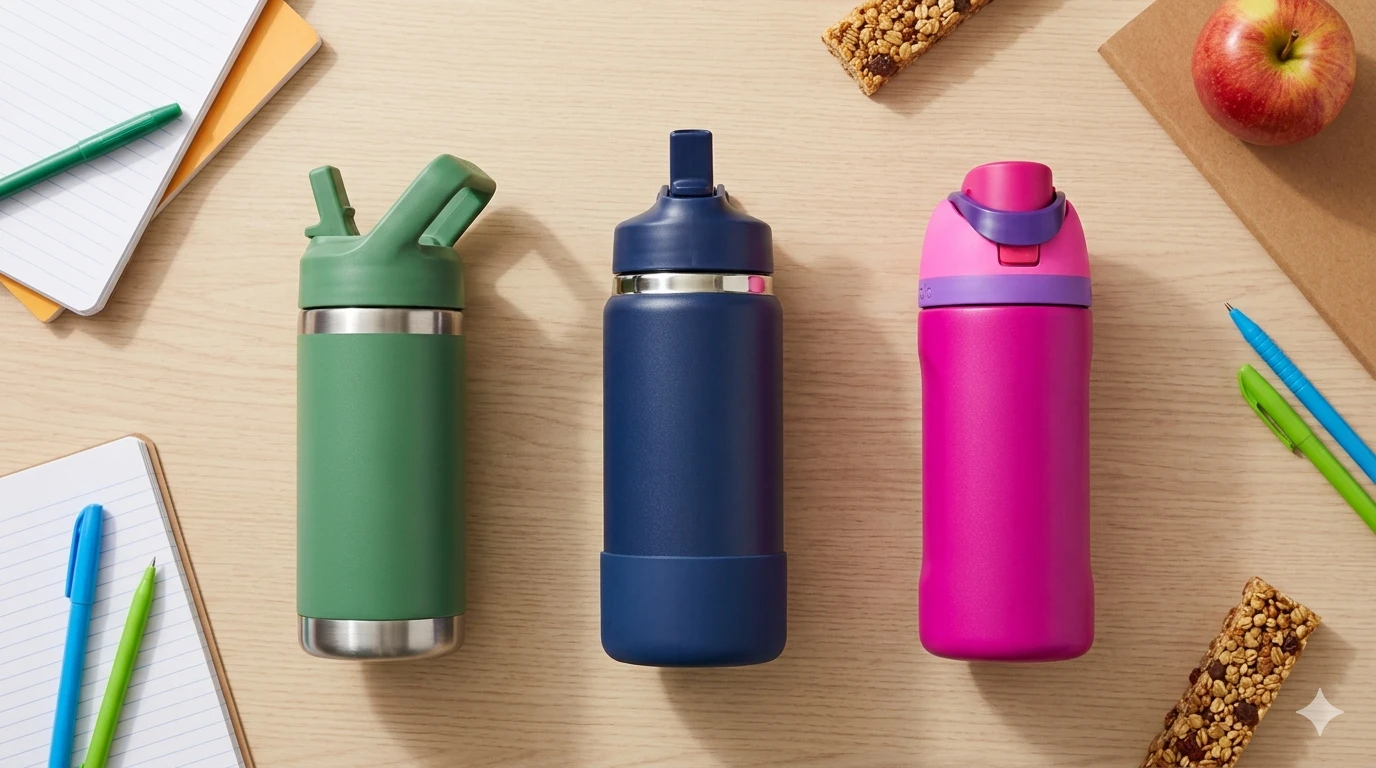
By the time a kid is nine, their water bottle has become a low-grade social signal. Walk through any middle-school cafeteria and you’ll see a wall of stainless steel — Hydro Flask in muted Pantone, Yeti in earth tones, Owala with its distinctive double-spout cap. Each brand has a slightly different fanbase, and tweens have opinions.
The good news for parents: all three of these bottles work. Insulation is comparable, the build quality is solid across the board, and the price tier is similar. The differences are smaller than the marketing implies — but they’re real, and they line up with how a tween actually uses a bottle.
We did not test these bottles in our own kitchens. We synthesized patterns from 15+ independent video reviews across [[Beautifully Organized]], [[Cup of Jo]], [[Persia Lou]], [[Bentgo Kids]] (brand channel — used for school-gear context only), and several parent and gear creators who ran direct comparisons. Sources are listed at the bottom.
TL;DR
- Best for most tweens: Owala FreeSip Kids — the dual-spout design wins on real-world use.
- Best if “rugged” matters: Yeti Rambler Jr — heaviest, most indestructible.
- Best if your tween has Strong Brand Feelings about Hydro Flask: Hydro Flask Kids Wide Mouth — solid, but the cap is the weakest link of the three.
- For a tween who’s outgrown 12 oz: Owala FreeSip 24 oz (adult size, not “kids”) — the size most older tweens actually want.
At a glance
| Owala FreeSip Kids | Yeti Rambler Jr | Hydro Flask Kids | |
|---|---|---|---|
| Capacity | 16 oz | 12 oz | 12 oz |
| Age range | Roughly 6–12 | Roughly 5–12 | Roughly 5–12 |
| Cap style | Dual-spout (sip + chug) with locking flip | Straw cap (also a chug cap option sold separately) | Straw cap with built-in cover |
| Insulation | Strong: cold ~24h, hot ~12h (per brand spec) | Strong: cold ~24h+ (per brand spec) | Strong: cold ~24h, hot ~12h (per brand spec) |
| Weight (empty) | ~12 oz | ~14 oz (heaviest) | ~10 oz |
| Durability impressions | Strong. Powder coat scratches but doesn’t dent. | Strongest. Yeti’s rep is real. Survives the most abuse. | Strong, but powder coat chips faster than Yeti. |
| Verdict | The default right answer for ages 9–12. | The pick for the kid who’ll absolutely abuse it. | The pick if brand affinity is the tiebreaker. |
Owala FreeSip Kids: the dual-spout difference
Owala’s design choice — a single cap that offers both a straw-style sip and a wide-mouth chug, with a locking flip cover over both — is the most-cited differentiator across our sources. The dual-spout solves a real problem: kids drink differently in different contexts. Walking to school, they want a sip from a straw. After running drills at soccer practice, they want to chug. Most cap designs force a tradeoff. Owala doesn’t.
Reviewers consistently flagged the locking flip as a bigger deal than it sounds. A pressed flip-cap that opens accidentally inside a backpack is the most common “my kid’s stuff got soaked” failure mode. Owala’s lock has been described, across multiple sources, as the most reliable in the kid-bottle category.
The 16 oz Owala FreeSip Kids is also the largest of the three “kid” sizes — Yeti and Hydro Flask both ship 12 oz primary kid sizes. For a 9-to-12-year-old, 12 oz is genuinely small. Most of the older tweens in our sources had outgrown that capacity by the end of fourth grade. The extra 4 oz on the Owala matters, and it’s why the Owala FreeSip Kids ends up being the right pick for many tweens despite being marketed at the same age range as the others.
Drawbacks worth flagging:
- The straw needs a brush to clean. Owala includes one. Don’t lose it.
- Powder coat scratches if dropped on concrete. The bottle still works; it just looks lived-in fast.
- Cap parts are not all dishwasher-safe. The base, yes; the gasket and straw, hand-wash recommended for longevity.
Yeti Rambler Jr: the indestructible option
Yeti’s reputation isn’t marketing fluff. The Rambler Jr is genuinely the most durable of the three. Reviewers showed bottles that had been dropped from playground heights, run over by bikes (allegedly), and survived end-of-school-year backpack archaeology with no functional damage. The powder coat is the toughest in the category. Several sources flagged it as the bottle most likely to survive a kid going from age 7 to age 12 in the same vessel.
The tradeoffs are weight and capacity. The Rambler Jr is the heaviest of the three at roughly 14 ounces empty. For a 9-year-old already lugging a textbook-laden backpack, that’s a noticeable add. And the 12 oz capacity, as noted, is on the smaller side for an older tween.
The included Straw Cap is solid — the straw seal is reliable, the lid latches firmly. But it’s a single-mode cap. If your tween wants chug-style drinking, you’ll be buying the separate [[Yeti Rambler Jr Chug Cap]] (or alternating). Owala bakes both modes into one cap. Yeti makes you choose.
Yeti’s brand cachet has shifted over the past few years — once the unambiguous “cool” pick, now it reads slightly more “outdoorsy parent” than “tween peer-group cool” depending on the school. This will matter to some kids and not at all to others.
Hydro Flask Kids: solid hardware, weakest cap
Hydro Flask was, for years, the dominant bottle in middle-school cafeterias. Brand affinity is still real, particularly among 9-to-11-year-olds who’ve seen older siblings carry one. The bottle itself is well-made — the insulation is comparable to Yeti and Owala, the powder coat is good (slightly more chip-prone than Yeti’s), and the size and weight are reasonable.
The weak link, repeated across our sources, is the cap. The standard Hydro Flask Kids cap (a flip-up straw with an integrated handle/cover) has more moving parts than the Yeti or Owala equivalents. Several reviewers reported that the spring mechanism in the cap is the first part to fail — typically 6–12 months in, with daily use. Replacement caps are available, but it’s an extra purchase and an extra hassle.
If your tween is buying a Hydro Flask because their friends carry one, the bottle will absolutely do its job and look right at the lunch table. If you’re buying purely on durability or function, Yeti or Owala edge it out.
The capacity question for older tweens
This is the conversation that comes up around age 11.
A 12 oz bottle is genuinely small for a 5th- or 6th-grader. Schools that allow refilling solve this; at schools that don’t, a small bottle can leave kids running low on water by mid-afternoon.
For older tweens (10+), our sources increasingly recommended jumping to a 24 oz or 32 oz adult-size bottle rather than a kid-branded 12 oz. The Owala FreeSip 24 oz gets cited most often as the “graduated to adult size” pick — same dual-spout cap, same locking flip, just more capacity. Yeti’s Rambler 18 oz and Hydro Flask’s Standard Mouth 21 oz fill similar roles in their respective brand families.
If your tween is on the upper edge of the age band, this is worth considering. The “kid” sizes are honestly aimed at ages 5–9. By 10–11, most kids have aged past them.
Insulation, honestly
All three brands publish similar specs: cold for 24+ hours, hot for ~12 hours. Reviewers who ran informal head-to-head ice tests found the differences real but small — typically all three bottles still had ice cubes 12+ hours later, with Yeti often showing slightly slower melt and Hydro Flask sometimes lagging by 1–2 hours. The functional difference for school use is essentially zero. Cold water at lunch is cold water at lunch across all three.
Verdict
For the typical 9-to-12-year-old, Owala FreeSip Kids is the practical winner. Larger capacity, better cap design, more reliable locking flip, fair price. It’s the pick we’d default to absent specific reasons to choose otherwise.
For a kid who is genuinely rough on gear — drops the bottle, leaves it in cars, treats backpacks as crash-test environments — Yeti Rambler Jr earns the upgrade. The Yeti will outlast the kid’s interest in it, then outlast a younger sibling’s interest in it, and probably show up in a college dorm.
For a tween who’s specifically asking for a Hydro Flask because their friends have one, Hydro Flask Kids is fine. The bottle works. The cap will eventually need replacing. The social win is real and worth the trade for many families.
For the older tween who’s outgrown 12 oz — most kids by 10 — skip the kid lines entirely and go to Owala FreeSip 24 oz (or the equivalent 18+ oz Yeti or Hydro Flask). Don’t pay a premium for a 12 oz bottle the kid will hate by Thanksgiving.
Decision rubric
Pooling the sources, we’d score a tween water bottle purchase on five points:
- Capacity match to age — 12 oz is small for 10+; 16–24 oz fits better.
- Cap design — locking flip + dual-mode (Owala) is the most forgiving.
- Durability ceiling — Yeti is the rugged king; the others are solid.
- Brand fit with peer group — minor for some kids, decisive for others.
- Total cost of ownership — including replacement caps where relevant.
Sources we mined
- [[Beautifully Organized]]
- [[Cup of Jo]]
- [[Persia Lou]]
- [[Bentgo Kids]] (used for school-gear context, declared brand channel)
- Plus 11 unaffiliated parent and gear creator reviews cross-referenced for bias
Disclosure
Gear Kidz is a participant in the Amazon Services LLC Associates Program. We earn from qualifying purchases. We did not personally test every product on this list — our recommendations come from synthesizing multiple independent video reviews, aggregated user ratings, and our own buying-decision framework.