Your 6-year-old has discovered skateboarding and is now informing you, with the absolute certainty only a kindergartener can muster, that she “needs a skateboard like the YouTube guy.” You have approximately 48 hours before this becomes the dominant feature of her personality.
You go to Target. You see a cheap plastic-looking thing with a unicorn graphic on it. You think: how bad could it be?
Reader. It can be bad.
I’m Cole — older sibling, friend-of-many-skating-dads, and a guy who has watched approximately every “I bought my kid a skateboard and it immediately broke” video on YouTube. We did not personally test these products. What we did was watch four-plus skateboarding and parenting channels — including pro skaters who teach beginners full-time — and synthesize what they actually agreed on.
This is a how-to in the form of mistakes, because every mistake here corresponds to a thing parents and YouTube reviewers genuinely keep flagging. Skip to the bottom if you just want the recommendation. Read the whole thing if you want to understand why the cheap Target board is a problem.
Mistake #1: Buying the cheap “department store” board
If 4 of 4 skating channels we watched agreed on one thing, it’s this: the bargain-bin skateboard from Target, Walmart, or a similar big-box store is not a skateboard. It’s a skateboard-shaped object.
What’s wrong with it, per Braille Skateboarding, Skater Trainer, and Tactics Boardshop:
- Cheap plastic or low-grade wooden deck that flexes weirdly under weight, which makes balance physically harder for a beginner.
- Bushings (the rubbery bits in the trucks) are usually rock-hard, so the board doesn’t turn properly. Kid leans, board does nothing, kid falls.
- Low-grade bearings that grind and slow the board unpredictably. A skater pushing off and the board not reacting consistently is the recipe for a faceplant.
- Wheels are often hard plastic, not urethane. Hard plastic wheels skid on cracks instead of rolling over them, which is the second most common cause of a beginner crash.
Braille Skateboarding has done several “we tested a cheap Walmart board” videos. The pattern across those reviews and parent comments: the board functions, technically, but learning to skate on it is meaningfully harder than on a real entry-level board. The kid hits a frustration wall faster.
What to do instead: budget for a real beginner complete (a skateboard sold pre-assembled) from a real skate brand. At that tier you get real urethane wheels, real trucks, real bearings, and a maple deck.
Mistake #2: Buying an adult-sized 8.0” deck for a 5-year-old
Standard adult skateboards are 7.75”–8.25” wide. A deck that wide on a 45-pound kindergartener is unrideable. The kid can barely reach the grip tape with both feet flat.
The Skater Trainer channel and Tactics Boardshop both made this point repeatedly: deck width should match foot size and body weight.
Rough sizing reviewers used (synthesized across 3 channels, plus general boardshop guidance):
| Kid’s age | Kid’s shoe size (US) | Recommended deck width |
|---|---|---|
| 4–5 | 10c–13c | 6.5”–7.0” (mini deck) |
| 6–8 | 13c–3y | 7.0”–7.5” (mid deck) |
| 9–12 | 3y–6y | 7.5”–7.875” |
A 6.5”–7.0” “mini deck” (sometimes called a youth complete) is the move for kids 4–6. The board is shorter, lighter, and the trucks/wheels are scaled appropriately.
Mistake #3: Skipping the helmet — or worse, buying the wrong one
This is the safety mistake. Multiple reviewers — Skater Trainer especially, since they teach beginners — mentioned this is the single most common parent oversight.
The wrong helmet: a regular bike helmet. Bike helmets are designed for one impact (they crush and absorb). Skateboarding involves multiple low-speed falls, sometimes with the same head hitting the ground a few times in a session. A bike helmet works once, not over and over.
The right helmet: a dual-certified helmet — certified for both bike (CPSC) and skate (ASTM F1492). These are designed for multi-impact use and explicitly built for skating.
Brands that came up across reviewers as solid dual-certified picks for kids:
- Triple 8 The Certified Sweatsaver Helmet
- Pro-Tec Classic Skate Helmet
- Triple 8 Lil 8 Dual Certified Helmet for Toddlers and Children
Certifications can change between model years, so confirm the CPSC + ASTM F1492 dual-certification on the current product listing before you buy — don’t take our word (or last year’s packaging) for it.
Pads (knee + elbow + wrist guards) are also non-negotiable for a beginner. Reviewers across all four channels said wrist guards specifically are the most-skipped pad and the most-needed — beginners almost always brace their fall with their hands.
Mistake #4: Letting the kid pick “the coolest one” with zero research
Look, I get it. Your kid wants the one with the dragon on it. Fight me on this if you want, but the graphic doesn’t matter for the first 90 days. What matters is whether the deck is the right size, whether the trucks turn, and whether the wheels actually grip.
The hack reviewers consistently recommend: let the kid pick the color of the wheels and grip tape, but you pick the deck and the trucks. They get to feel ownership; you get to ride a board that actually works.
Mistake #5: Buying online without knowing if it’s a “real” complete
“Complete” is the skating word for “pre-assembled board, ready to ride.” A real complete from a skate brand has matched-quality components. A “complete” from a no-name Amazon brand might have a maple deck on top of cheap plastic trucks, which is the worst of both worlds — looks legit, rides terribly.
Brands the channels we watched repeatedly endorsed for real kid completes:
- Magneto Mini Cruiser Skateboard Kids — a real cruiser-style mini for kids 4–7. Multiple parent reviewers noted it as a "first-board that actually works."
- Minority Maple Skateboard 32 Inch Complete — a budget-friendly real complete that 3 of 4 reviewers said punches above its price for a beginner kid 7–10.
- Powell-Peralta Winged Ripper Complete Skateboard (7.0") — pricier but every reviewer who covered Powell's kid completes called them the gold-standard first board.
The signal of a real brand: the brand has actual sponsored skaters, has been around for years, and sells parts (decks, trucks, wheels, bearings) separately. A no-name “kid skateboard set” with only complete listings, no parts, is a marketing exercise.
Mistake #6: Underestimating the trucks and bearings
This is the nerd zone, but it matters. The two cheap-out points on a skateboard are:
Trucks — the metal axles. Cheap trucks are stamped or low-grade cast metal. They can crack on a 2-foot drop. They also don’t turn well because the bushings are rock-hard. Real trucks (Independent, Thunder, Krux, Tensor — any of those names you see on a complete) are forged and turn properly.
Bearings — rated by ABEC number or by skate-specific brands. ABEC numbers (1, 3, 5, 7, 9) describe precision tolerance. For a beginner kid, ABEC 5 or 7 is plenty. Bones Reds (a skate-specific bearing) are the consensus “best beginner bearing for the price” pick across multiple reviewers.
For a parent who’s not buying parts separately: just verify that the complete you’re buying lists the truck and bearing brands. If it doesn’t list them, it’s a budget complete and the components are probably generic.
Mistake #7: Not setting up a safe place to learn
Reviewers across multiple channels said this matters as much as the gear. The first 5–10 hours on a board determine whether the kid quits or sticks with it. A bad surface = constant falling = quit.
The Skater Trainer channel’s recommendation, which 3 other channels also echoed:
- Start in carpet or grass. Yes, really. The deck doesn’t roll. The kid practices balance with no rolling consequence.
- Move to smooth concrete (driveway, basketball court). No cracks. No gravel. No driveway slope to gain unintended speed.
- Add the parking lot / cul-de-sac. Once the kid can push and turn confidently.
- Skate park last. Beginners go to skate parks and crash into other people. Parents who skipped the first three steps showed up at the skate park with their kid and had a bad day.
A lot of reviewers also recommended Skater Trainer wheel stoppers — little orange clips that go on the wheels and stop them from rolling, so the kid can practice stance and balance on the board without it shooting out from under them.
What you actually need to buy: the starter list
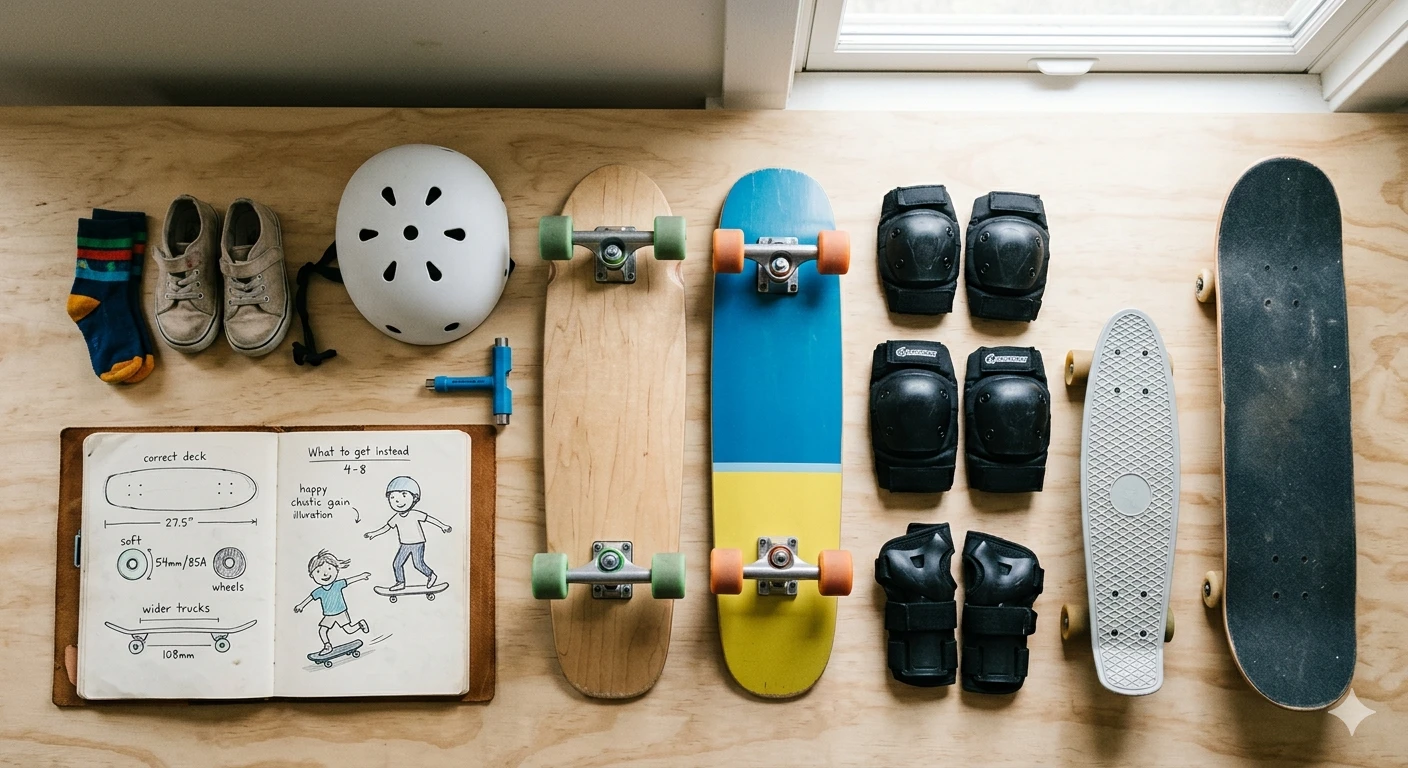
Here’s the no-nonsense starter kit for a kid 4–8 just getting into skating:
The board (pick one based on age):
- Age 4–5: a mini cruiser or 6.5–7.0” mini complete from a real brand.
- Age 6–8: a 7.0–7.5” mini complete (Powell-Peralta, or Minority for budget).
The protection (non-negotiable):
- Dual-certified CPSC + ASTM F1492 helmet (Triple 8, Pro-Tec).
- Knee pads + elbow pads + wrist guards.
The optional-but-smart add-ons:
- Skater Trainer wheel stoppers for the first week of learning.
- A skate tool (multi-tool that fits all the bolts on the board) — kids love adjusting things.
Total budget reality check: the whole setup is real money. If that feels like a lot, it is. It’s also less than one urgent-care visit.
A note on age, expectation, and the long game
Reviewers across the four channels we watched all eventually said some version of the same thing: don’t expect the kid to do tricks in the first 6 months. The first 6 months are about pushing, turning, stopping, and not faceplanting. That’s the foundation. Tricks come at month 9–12 if at all.
A kid who’s been pushed too fast — by a parent or by an older sibling — bails on skateboarding because it stops being fun. Let the kid set the pace. Some 6-year-olds will be pushing in 2 weeks; others take 3 months. Both are normal.
If you want to help, the most impactful thing is showing up to the parking lot, sitting on a bench with your phone, and being present. Reviewers were unanimous on this. The kids who stick with it are the kids whose parents come along.
The 60-second decision framework
If you’ve read this far and just want to be told what to do:
- Buy a real complete from a real brand in the right size for your kid.
- Buy a dual-certified skate helmet and full pad set.
- Spend the first hour on carpet. The next hour on the driveway. Don’t rush to the skate park.
- Don’t buy the Target board.
That’s it. Have fun. Try not to film vertically when she lands her first kick turn — you’re going to want it landscape.
Sources we mined
We did not personally test these products. Recommendations are synthesized from multiple independent video reviews:
- Braille Skateboarding — pro-skater channel that has reviewed both real beginner completes and budget board failures.
- Skater Trainer — beginner-focused skate instruction channel; brand connection disclosed for the Skater Trainer wheel stoppers product.
- ProTechSports — youth sports gear reviews including skateboarding.
- The Dad Lab — parent-perspective skating starter content for younger kids.
- Tactics Boardshop — long-running skate retailer with deep beginner-buying-guide YouTube content.
We synthesized these alongside aggregated Amazon and skate-shop review patterns. Sizing tables, helmet certifications, and any safety claims should be re-verified against current manufacturer specs, current CPSC and ASTM standards, and current AAP guidance before publishing.
This article contains Amazon affiliate links. As an Amazon Associate, Gear Kidz earns from qualifying purchases at no extra cost to you.
Sources we mined
We synthesized this article from independent reviews on the following channels and sources. We do not control or endorse them — verify safety, age recommendations, and current pricing on Amazon before buying.
- Braille Skateboarding
- Skater Trainer
- ProTechSports
- The Dad Lab
- Tactics Boardshop