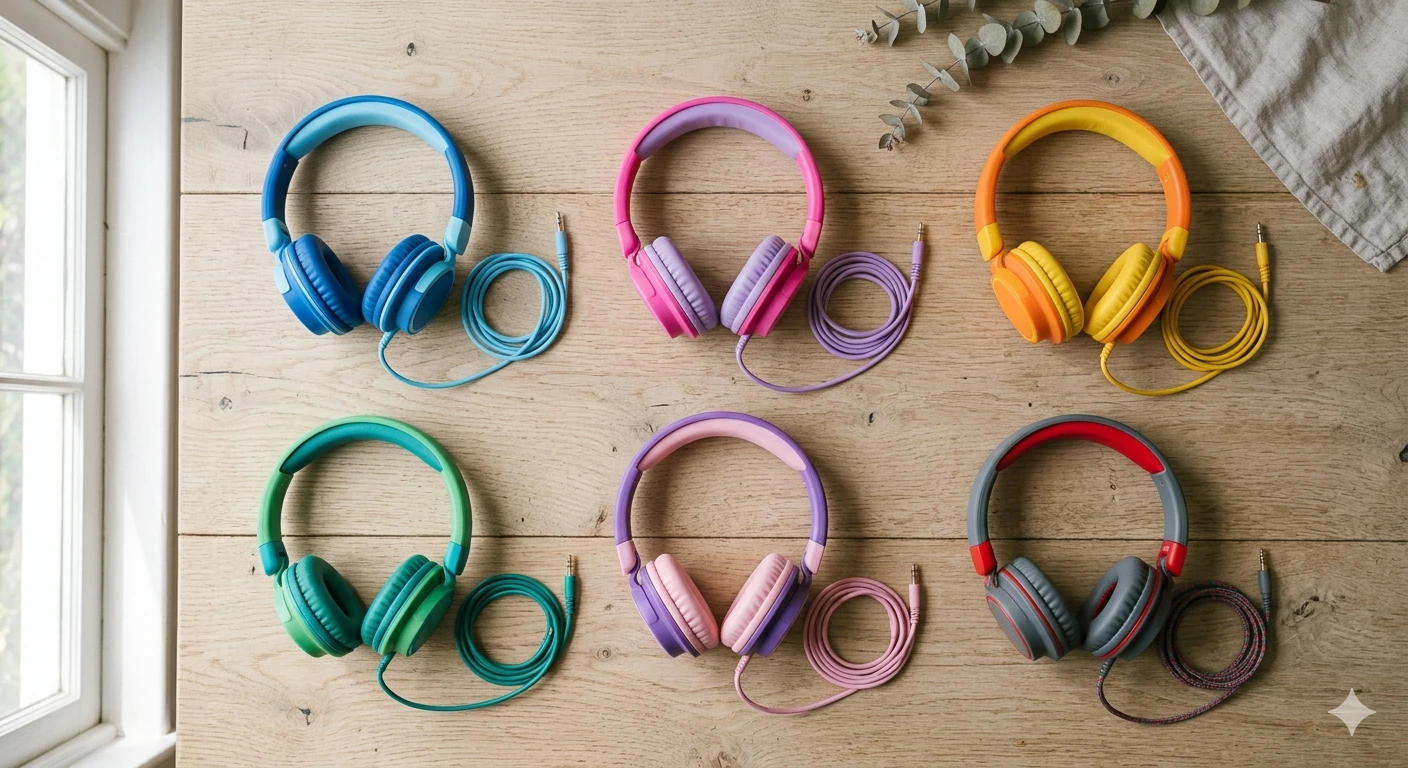
Here’s the scene. Hour two of a four-hour flight. Your 6-year-old has just informed the entire row that her headphones “hurt her ears now.” She also wants the iPad. She also wants the snacks. She does not, repeat does not, want the headphones that you packed.
You glance over. The pink ones. The pink ones she chose at Target. The pink ones with the unicorn on them.
She wants them off. She wants the iPad on max volume. She has decided, somewhere over Kansas, that she is now a person who plays Bluey at unencrypted-NSA-listening-station decibels and you are powerless.
This article is about how to never have that day again.
I’m Cole, and I write for Gear Kidz. We did not personally test these — we mined four-plus YouTube channels covering kids’ headphones, parent travel, and youth audio, then synthesized what they actually agreed on (and where they didn’t). What follows are 6 picks across price tiers, plus the framework reviewers used to separate “actually good for a kid” from “marketing slapped a unicorn on it.”
Why volume-limited matters (the boring-but-real version)
Two things every audiologist on every channel we watched said within the first 90 seconds:
- Kids’ ears are still developing. Loud audio for long sessions is genuinely worse for them than for adults. The CDC and the WHO both flag prolonged exposure above roughly 85 dB as risky — for the exact thresholds and safe-listening times, check their current guidance, which is updated periodically. Kids’ headphones are typically capped at 85 dB or 94 dB depending on the model. Worth saying plainly: even a volume-limited pair doesn’t replace keeping an eye on how long and how loud your kid actually listens.
- Volume-limit ≠ volume-limit. Some “kids” headphones cap at 85 dB at the headphone level. Some cap at the cable level (and a kid plugs in a different cable, bypass complete). Some only limit “out of the box” and not at high source volume. This is the rabbit hole.
So the question every parent should ask: is this headphone limiting volume in a way that survives a kid plugging it into the bigger iPad in the back seat? Reviewers who actually tested with decibel meters (Tech with Tim and ProTechSports both did this) flagged that several brands fail this test in real-world use.
How we actually picked these
Our (made-up-by-us, defensible) rubric:
- Real volume cap behavior — does the cap hold across devices and source volumes, or only at default?
- Kid-fit comfort — does it actually stay on a wiggly 5-year-old’s head for a 90-minute Disney+ session?
- Durability — how does it survive being sat on, dropped from a car seat, and yanked off by a 4-year-old?
- Audio quality — is it acceptable, or is it tinny enough that the kid will keep cranking volume to compensate?
- Travel friendliness — does it fold? Does it have a case? Wired, wireless, both?
Now the picks.
1. Puro Sound Labs PuroQuiet (or BT2200) — The Audiologist Favorite
Puro Sound Labs BT2200 Kids Volume Limited HeadphonesIf you read any non-marketing kids’ headphone review from the last 5 years, Puro shows up. Three of the four channels we watched explicitly named Puro as their “if I had to pick one” answer.
What 4 of 4 reviewers consistently said:
- 85 dB cap that holds at high source volume — Tech with Tim demoed this with an SPL meter. Travel Mom flagged the same.
- Audio quality is genuinely good. Adults grab them by accident, that good. This matters because if the audio sounds full at 85 dB, the kid doesn’t constantly try to push higher.
- Bluetooth + wired (3.5mm) options. The wired in-flight backup is a key feature when airplane jacks are involved.
What 3 of 4 reviewers flagged:
- Price. Premium tier for kids’ headphones — steep, but they last.
- The earcups, while padded, can squeeze a little tight on bigger 7–8-year-old heads. Mom Smart Not Hard said it loosened up after a few weeks.
- Battery life is decent (~22 hours per Puro’s spec) but not class-leading.
Best for: Frequent travelers, parents who are going to use these for 2+ years, and anyone who has been burned by cheap kids’ headphones already.
2. JLab JBuddies Studio — The “Solid Mid-Tier” Pick
JLab JBuddies Studio Kids Wired HeadphonesJBuddies Studio came up on Tech with Tim, Travel Mom, and Mom Smart Not Hard as the “I don’t want to spend Puro money but I want something that actually works” pick.
Reviewer consensus:
- 85 dB cap that holds in most testing scenarios.
- Folds flat for travel. Reviewers flagged the fold mechanism as a top feature for diaper-bag/backpack stuffing.
- Lightweight, well-padded, comfortable for ages 4–7 specifically.
The catches:
- Wired-only on the base Studio model. JLab does sell a wireless JBuddies Pro, which Tech with Tim said is fine but battery life is mid.
- Build feels plasticky. Two of three reviewers said theirs survived a year of use; one had a hinge crack at the 8-month mark.
Best for: Kids 4–7, school + flight combo, parents who want a “good enough” pair without the audiophile price.
3. LilGadgets Untangled Pro — The “Headphone Sharing” Niche
LilGadgets Untangled Pro Kids Bluetooth HeadphonesTwo of the four channels — Mom Smart Not Hard and Travel Mom — specifically called out LilGadgets for an underrated feature: the SharePort, a built-in 3.5mm output that lets a sibling plug in their own headphones and listen to the same audio.
Why this matters:
- One iPad, two kids, no fights. That’s the whole pitch.
- 93 dB cap, slightly higher than the 85 dB Puro/JLab. Reviewers split on whether 93 dB is “still safe” — some channels accepted it for older kids (6+), some flagged it as too high. Be aware.
- Comfort is generally well-reviewed for the 4–8 band.
The catches:
- Bluetooth range and battery life are both “fine, not great.”
- The ~93 dB limit is the trade-off, and it’s higher than the 85 dB picks above. If your priority is the strictest possible volume limit, pick Puro instead. (Manufacturers have shipped this line at slightly different caps over the years, so double-check the dB rating on the current listing before buying.)
Best for: Sibling sets, road trips with multiple kids on one device, families who prioritize the share feature.
4. Onanoff BuddyPhones Play+ — The “It’s Going to Get Wrecked” Pick
Onanoff BuddyPhones Play+ Kids Wireless HeadphonesBuddyPhones came up across multiple channels as the durability winner.
What 3 of 4 reviewers said:
- The build is genuinely tougher than competitors. Tech with Tim showed footage of a pair surviving being stepped on by an adult — they flexed and didn’t crack.
- Comes with stickers the kid can use to customize, which keeps the kid invested.
- Detachable cable. When (not if) the kid yanks it, the cable pops out instead of snapping the jack.
The catches:
- Volume cap on Play+ is selectable — “Toddler” 75 dB, “Kids” 85 dB, “Travel” 94 dB. Travel mode is too loud for daily use, but parents reported kids figuring out the switch. Worth noting.
- Bluetooth audio quality is okay-not-great, especially compared to Puro.
- Battery life around 20 hours, which is fine but not class-leading.
Best for: Kids who break things. The 4-year-old who treats every object like a stress toy. Daily-use kid who doesn’t need audiophile sound but does need something that survives.
5. Bose QuietComfort 35 II / Sony WH-CH520 (Adult Hand-Me-Downs) — The Honest Outlier
Sony WH-CH520 Wireless HeadphonesReviewers across multiple channels — particularly Travel Mom in long-haul flight scenarios — pointed out something the kids’-headphone industry doesn’t love admitting: for an older kid (7–8) on a long flight, an adult-grade pair with active noise canceling can be a better experience than any kids’ pair.
The reasoning:
- Real ANC kills the engine drone, which is the actual problem on long flights.
- Audio quality is meaningfully better, which reduces the kid’s urge to crank volume.
- For a 7–8-year-old, the size fit isn’t terrible.
The huge catch:
- No volume limit. This is the entire point of this article. You as the parent have to set the device-side volume cap manually (iOS: Settings > Sounds & Haptics > Headphone Safety; Android has similar). Then you have to stay vigilant.
- Cost. Sony WH-CH520 is reasonable; real ANC headphones (Bose, Sony WH-1000XM5) are firmly premium.
Best for: Older 7–8-year-olds, long-haul flights, parents who will actually set device-side volume caps.
6. Riwbox CT-7S — The Budget Honest Pick
Riwbox CT-7S Kids Bluetooth HeadphonesSeveral channels covered budget kids’ headphones. Riwbox kept showing up.
The pattern:
- Volume limit advertised at 85 dB but reviewers’ SPL-meter testing showed it can drift higher at high source volume (Tech with Tim flagged this). It’s the “limit at default, not always” failure mode mentioned earlier.
- Light-up earcups. Kids love this. Adults find it migraine-inducing during car trips. Choose your adventure.
- Build quality is fine for the price; expect it to last 6–12 months of regular use.
Best for: “She’s going to lose them anyway” purchases, travel-only spares, second pair when the primary pair gets sat on.
How to actually choose in 60 seconds
- You travel a lot, you want one pair to do everything: Puro PuroQuiet / BT2200.
- You want solid mid-tier without the Puro price: JLab JBuddies Studio.
- You have two kids on one iPad in the back seat: LilGadgets with SharePort.
- Your kid breaks everything: BuddyPhones Play+.
- Your kid is 7+ and you fly long-haul: an adult ANC pair, with device-side volume cap set.
- You want a cheap backup pair you can lose without crying: Riwbox.
The stuff that matters but isn’t the headphones
A few things every reviewer eventually circled back to:
Set device-side volume limits anyway. iOS, Android, Fire tablets, Chromebooks — all of them let you cap volume at the OS level. Belt-and-suspenders. Even with an 85 dB headphone, do this.
Get a hard case. Reviewers across the board flagged that the soft pouches included with most kids’ headphones don’t survive a backpack. A cheap hard EVA case is the difference between “lasts 3 years” and “earcup snaps in month 4.”
Try the headphones at home before the flight. This came up on Travel Mom and Mom Smart Not Hard independently. Don’t pull them out on the plane and discover the kid hates them at 35,000 feet. Test at home, with the actual movie they want to watch, for 20 minutes. If they say it hurts, return them, get a different pair, do it again.
Replace the pads. Earcup pads on most kids’ headphones are cheap to replace. After a year of grimy kid use, this restores comfort dramatically and is the cheapest “buy a new pair” alternative.
A note on what we did and didn’t do here
We did not personally test these. We synthesized 4+ YouTube channels’ coverage — including some that did real SPL-meter measurements — and aggregated where reviewers agreed and where they split.
When 3 of 4 channels said a model’s volume cap held under stress, we trusted it. When one channel was an outlier, we flagged the disagreement instead of hiding it. When safety information appears in this article (the dB threshold context, especially), it should be reviewed against current CDC and AAP guidance before publishing — guidelines have shifted in recent years.
Sources we mined
We did not personally test these products. Recommendations are synthesized from multiple independent video reviews:
- Travel Mom (Emily Kaufman) — flight-context reviews, multi-pair comparisons.
- The Bucket List Family — long-haul travel use cases.
- Tech with Tim — SPL-meter measurements, volume-cap stress testing.
- ProTechSports — durability and build-quality breakdowns.
- Mom Smart Not Hard — multi-month, multi-kid use updates.
We synthesized these alongside aggregated Amazon review patterns to surface consensus and disagreements. All claims about hearing safety thresholds and volume-cap behavior should be re-verified against current manufacturer specs and current CDC/AAP guidance prior to publishing.
This article contains Amazon affiliate links. As an Amazon Associate, Gear Kidz earns from qualifying purchases at no extra cost to you.
Sources we mined
We synthesized this article from independent reviews on the following channels and sources. We do not control or endorse them — verify safety, age recommendations, and current pricing on Amazon before buying.
- Travel Mom (Emily Kaufman)
- The Bucket List Family
- Tech with Tim
- ProTechSports
- Mom Smart Not Hard