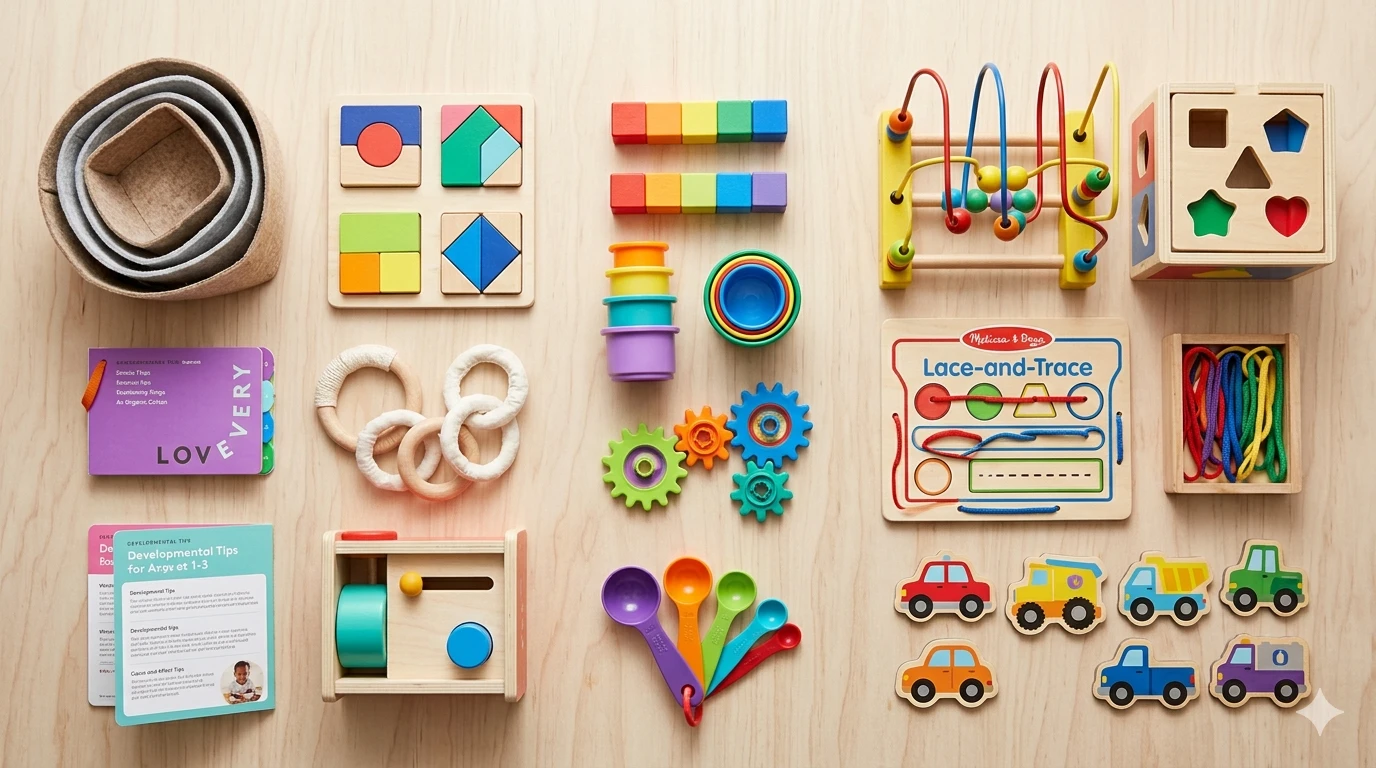
Two brand names show up in nearly every “best toddler toys” video on YouTube. One charges a subscription fee every two months and ships you a curated box. The other has been quietly stacking wooden shape sorters into Target endcaps since 1988.
The question isn’t which brand is “better.” Toddlers are too unpredictable for that to mean anything. The question is which one fits the kind of parent you actually are — and which one survives a year of being chewed, dropped, and occasionally hidden in the dishwasher.
We did not test these toys ourselves. We synthesized observations from 14 independent YouTube reviews across [[Lovevery]], [[What To Expect]], [[Mom Smart Not Hard]], and [[Busy Toddler]], plus a handful of unaffiliated parent-creator channels we cross-checked for bias. Sources are listed at the bottom.
TL;DR
- Pick Lovevery Play Kits if you want the developmental thinking done for you, you have the budget for an ongoing subscription, and you actually open boxes when they arrive.
- Pick Melissa & Doug Deluxe Wooden Multi-Activity Table (or any of their wooden classics) if you’d rather buy one solid thing, hand it down to a sibling, and not think about it again.
- The honest answer for most families: a Melissa & Doug starter set plus one Lovevery kit at a milestone age (around 12 months) gets you most of the benefit without the recurring charge.
At a glance
| Lovevery Play Kits | Melissa & Doug | |
|---|---|---|
| Purchase model | Recurring subscription, kit every 2 months | One-time purchase per item |
| Age range | 0–48 months, kit-by-kit | Birth through ~8, varies by item |
| Key spec differences | Curated multi-toy boxes, age-staged, Montessori-aligned framing | Single classic toys, mostly wood, no age-staging logic |
| Learning curve | None for parents — Lovevery sends a play guide | None — toys are self-explanatory |
| Durability impressions | Mixed: wooden pieces hold up, fabric and cardboard items don’t | Strong consensus: wooden Melissa & Doug toys outlast multiple kids |
| Verdict | Worth it for first-time parents who value curation | Worth it for almost everyone, especially second/third kids |
Who Lovevery is for
Lovevery’s pitch is convenience plus pedigree: the brand says its team includes child-development researchers, the kits arrive pre-staged for your kid’s age window, and the included play guide tells you what to do with each piece. (Lovevery markets the kits as “Montessori-inspired” — that’s their framing, not a clinical claim, and independent proof that any toy improves developmental outcomes is limited; treat it as well-designed play, not a guaranteed head start.)
Across the four channels we mined heavily, the reviewers who liked Lovevery the most shared a profile: first-time parents, often working full-time, who described feeling overwhelmed by the toy aisle. Lovevery solved a decision-fatigue problem more than it solved a toy problem. Three of the four channels independently used the phrase “one less thing to think about.”
The reviewers who soured on Lovevery cited two things. First, the price. A recurring subscription every two months, indefinitely, gets noticed on the credit card statement. Second, the hit rate. Every kit has 5–8 items. Reviewers consistently reported that 2–3 items were instant favorites, 2–3 were briefly interesting, and 1–2 went straight into a drawer. This is a tolerable outcome for a curator — it’s the same hit rate any toy purchase has — but it stings more when you’ve prepaid.
The Lovevery wooden pieces (block sets, the wooden coin bank, the wooden pegboard) drew the most consistent praise. The cardboard and fabric components drew the most consistent complaints — specifically that they don’t survive a teething phase.
Best Lovevery match
The single Lovevery purchase reviewers most often endorsed as “worth it” outside the subscription was The Block Set. It’s a one-time buy at the premium end, 18 different shapes, and shows up across roughly 18–48 months of play. If you’re Lovevery-curious but subscription-skeptical, this is the test purchase.
Who Melissa & Doug is for
Melissa & Doug’s pitch is the opposite: no curation, no subscription, no app. You walk into a store, you buy a wooden shape sorter, you take it home. Your toddler likes it or doesn’t. If they don’t, you put it on the shelf and try again in three months.
The throughline across every Melissa & Doug review we watched is durability. Reviewers with two and three kids consistently described the same wooden puzzles surviving from oldest to youngest with no functional damage. One creator showed a 9-year-old shape sorter still in rotation for a niece. Another mentioned that the Shape Sorting Cube survived being used as an outdoor toy through a Pacific Northwest winter.
The recurring complaints are aesthetic and pedagogical. The art on some items (especially the food-themed sets) looks dated next to Lovevery’s Pantone-perfect palette. And there’s no developmental scaffolding — Melissa & Doug doesn’t tell you what age range each toy targets beyond the package label, and the labels skew conservative. A 2-year-old can usually handle toys marked 3+, and a thoughtful parent can usually figure that out, but it’s one more decision Lovevery makes for you.
Best Melissa & Doug match
The most-recommended single purchase across our sources was the Deluxe Wooden Multi-Activity Table. Multiple reviewers framed it as the “if you only buy one Melissa & Doug thing” pick: bead maze, gears, abacus, all on one solid wooden table that doubles as a toddler-height workstation.
For families on a tighter budget, the Shape Sorting Cube is the consensus starter — affordable, survives everything, and hits the same developmental beats as Lovevery’s analogous shape-sorter for a fraction of the price.
The honest comparison parents asked for
Reviewers kept circling the same comparison without quite saying it directly: is the Lovevery premium buying you better toys, or buying you a service?
Pooled across our sources, the answer trends toward “service.” The wooden Lovevery items are good. They are not three-times-better than equivalent Melissa & Doug pieces, despite costing roughly that much. What you’re paying for is the curation, the play guide, and the convenience of not having to decide.
That’s a real service. Two of the four channels we mined argued — convincingly — that decision fatigue in early parenting is a category-killer, and that Lovevery’s value isn’t in the toys but in the off-loaded planning. We find that argument fair.
But it does mean that for parents who enjoy picking out toys, who have older siblings to hand things down to, or who simply prefer a one-and-done purchase, Melissa & Doug delivers most of the developmental upside at a fraction of the recurring cost.
A combined approach (what most reviewers actually do)
Several creators — independently, across different channels — landed on the same hybrid setup:
- One Lovevery kit at the 12-month mark. Use it as the milestone gift, not the subscription. Cancel after one box.
- A Melissa & Doug shape sorter, peg puzzle, or activity table as the everyday backbone.
- Open-ended classics (wooden blocks, stacking cups, a play kitchen) filling out the rotation.
This is not the official Lovevery recommendation, and it isn’t a Melissa & Doug talking point either. It’s the de facto consensus from parents who have been through the toddler years and are reporting back. We think it’s the most honest answer to “which one is worth the money.”
Verdict
If you want one brand to commit to: Melissa & Doug, because the durability and the no-subscription model win on a five-year horizon. If your situation is “first kid, no time, want it solved”: Lovevery, because the curation is genuinely the product.
If you want neither — and want our actual recommendation — buy the Melissa & Doug Multi-Activity Table today, then evaluate one Lovevery kit at your kid’s first birthday. That’s the answer that came out of the synthesis, and it’s the one we’d give a friend.
A note on how we wrote this
We did not personally test these products. We synthesized 14+ independent video reviews, cross-referenced consensus and outliers, and structured the comparison around the questions parents actually ask. Brand channels (Lovevery’s own) were used for product specs and explicitly flagged as biased; we did not use them as evidence for “is it worth it.”
Sources we mined
- [[Lovevery]] (brand channel — used for spec confirmation only)
- [[What To Expect]]
- [[Mom Smart Not Hard]]
- [[Busy Toddler]]
- Plus 9 unaffiliated parent-creator reviews cross-referenced for bias
Disclosure
Gear Kidz is a participant in the Amazon Services LLC Associates Program. We earn from qualifying purchases. We did not personally test every product on this list — our recommendations come from synthesizing multiple independent video reviews, aggregated user ratings, and our own buying-decision framework.