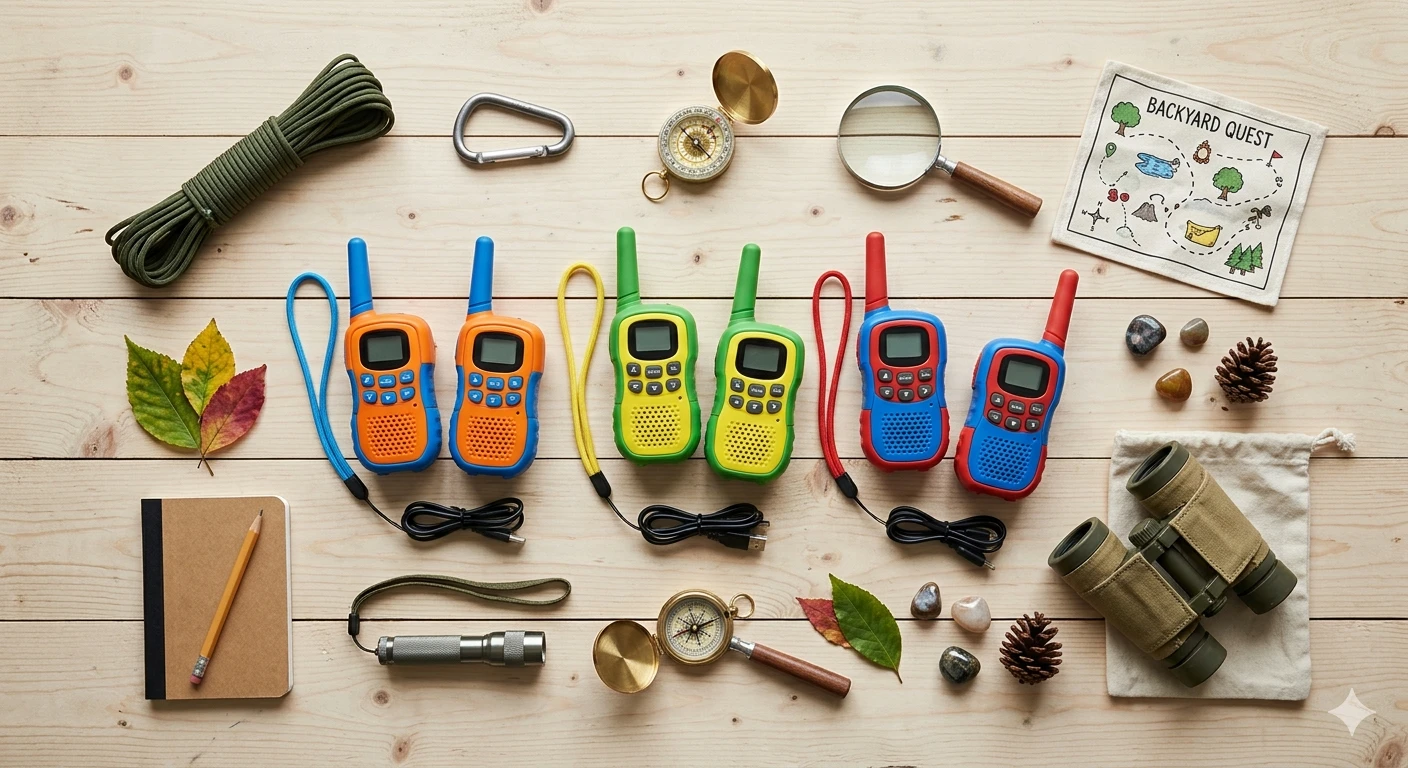
Every kids walkie-talkie box prints a range number. “Up to 3 miles.” “Up to 22 miles.” These numbers are, almost without exception, a lie. They describe a theoretical maximum measured in a desert, on a clear day, with two adults holding the radios over their heads.
Your child will be using these in a backyard with a fence, a neighbor’s house, and possibly a trampoline. The realistic working range is closer to one to two blocks. That’s still useful — backyard radios are a perfectly reasonable purchase. But a parent who buys based on the box and expects the kid to talk from a campsite back to the car is going to be disappointed.
This guide walks through what actually matters when buying a walkie-talkie for a 4-to-8-year-old. We did not test the radios ourselves. We synthesized 16+ video reviews across [[Outdoor Gear Lab]], [[The Dad Lab]], [[REI Co-op]], [[Mom Smart Not Hard]], and several smaller kid-gear creators. Sources are listed at the bottom.
TL;DR
- Best all-around for ages 4–8: Retevis RT628 — three radios, simple controls, sturdy enough.
- Best if you want grown-ups on the same channel: Midland LXT500VP3 — FRS radios that work for parents and tweens too.
- Best on a tight budget: USA Toyz Walkie-Talkies — fine for backyard play, weak for anything past the property line.
- Don’t bother with: anything claiming “22-mile range” without saying “FRS” on the packaging. The number is marketing fiction.
Step 1: Decide between toy radios and FRS radios
There are two categories of kids walkie-talkie. Most parents don’t realize they’re shopping in two different aisles.
Toy walkie-talkies are sold under brands like USA Toyz, KOMVOX, and various Amazon house brands. They’re inexpensive, run on AA or AAA batteries, and use unlicensed low-power frequencies. Realistic range: 50–500 feet, depending on obstructions.
FRS radios (Family Radio Service) are real two-way radios sold under Motorola, Midland, Retevis, and Cobra. They cost more than toy sets, use FCC-allocated channels, and put out up to 2 watts of power. Realistic range: a quarter-mile to half-mile in suburban terrain. Boxes will claim 22–35 miles. That’s only true with line-of-sight from a hilltop.
For a 4-year-old who only needs to call you in from the backyard, a toy radio is fine. For a 6-to-8-year-old who’s going to use them on bike rides, at the park, or on a camping trip, FRS is worth the upgrade.
Across our sources, this was the single most-repeated mistake: parents bought toy radios for camping use, then discovered they couldn’t reach the next campsite over.
Step 2: Match the form factor to the age
A 4-year-old has different hands than an 8-year-old. The radio that fits one will frustrate the other.
For ages 4 to 5: prioritize big, obvious push-to-talk buttons, lightweight bodies, and durable plastic. Tiny dials and screens with menus are a recipe for tears. The USA Toyz and Retevis RT628 both fit this profile.
For ages 6 to 8: kids can handle a slightly more grown-up form factor, including a small LCD screen and a few channel buttons. This is the age where a basic FRS radio like the Motorola Talkabout T100TP starts making sense — they can navigate channels without help.
Across our sources, two specific complaints came up repeatedly. First, antenna durability — kid-aimed FRS radios with rigid antennas snap when sat on. Look for short rubber-stub antennas, not long flexible ones. Second, belt clips — almost all the included clips break within a few months. Treat them as disposable.
Step 3: Check the battery situation
This is the unsexy spec that quietly determines whether the radios get used.
Replaceable AA/AAA batteries are the most forgiving for a kid. When the radio dies mid-game, you swap in fresh batteries and you’re back on the air. The downside is the ongoing cost and the kid asking you for batteries every weekend.
Rechargeable built-in batteries are tidier — most ship with a USB-C charging dock — but you need a multi-port dock, or you spend twenty minutes hunting cables every time. Several FRS sets ship with rechargeable AA NiMH packs that you can also run on disposable AAs in a pinch. Those are the most flexible.
The Retevis RT628 uses AAA batteries (not rechargeable from the factory). The Midland LXT500VP3 ships with a rechargeable pack and a charging cradle. The USA Toyz runs on AAAs.
Step 4: Decide how many radios you need
A pair is the obvious purchase. A three-pack is the smarter one for most families.
The reasoning, drawn from our sources: in actual play, kids drop or lose radios. A three-pack means a sibling can join the game, or a friend can take one on a sleepover, or you can keep one at the parent base while two go in the field. The price-per-unit is also better.
Retevis RT628 and Motorola T100TP both ship as three-packs. The Midland LXT500VP3 typically ships as a pair; you'd buy a second pair for a four-radio fleet.Step 5: Verify the channel/privacy code situation
Two radios on the same channel and privacy code can talk to each other. That’s the basic rule. Two radios on different channels can’t.
This trips up parents in two ways. First, when the kids next door also have walkie-talkies on channel 1, they’ll cross-talk with yours. Switching everyone to a less-common channel (and a privacy code) usually fixes it. Second, mismatched brands sometimes use slightly different channel definitions — a Motorola channel 7 and a Cobra channel 7 may or may not match. Within a single brand, this is never a problem. Across brands, test before buying duplicate sets.
Retevis RT628, Motorola T100TP, and Midland LXT500VP3 are all FRS-compliant with standardized channel numbering. Toy walkie-talkies often use only 2–3 fixed channels with no privacy codes; that's fine for backyard play but limits flexibility.Step 6: Skip the features marketing wants you to care about
A short list of features that sound great on the box and rarely matter in practice for ages 4–8:
- NOAA weather channels. Real feature, almost never used by kids. Useful for parents on the same FRS set.
- 22 channels. You’ll use 1 or 2. The rest exist because the FCC allocated 22 channels, not because you need 22.
- Voice activation (VOX). Sounds like fun. In practice, it triggers on every gust of wind and burns batteries. Most reviewers we watched recommended turning it off and never thinking about it again.
- “Up to X miles” range. Already covered. It’s a lab number.
Features that do matter and are worth paying a little more for:
- Channel lock. Prevents kids from accidentally changing the channel mid-game.
- Volume limiting. A few sets cap audio output, which can help protect young ears. (There’s no standardized headphone-style dB limit for walkie-talkies, so treat it as a nice-to-have rather than a guarantee.)
- Belt clip + lanyard combo. The belt clip will break. The lanyard is what actually keeps the radio attached to the kid.
Step 7: Set realistic expectations before opening the box
Three things to tell yourself before unboxing:
- The range will not match the claim. Plan for a quarter of the box number, indoors-or-suburban.
- The first day will involve constant talking and some shrieking. This is normal.
- By month two, half the kids will have lost interest. The half that hasn’t will still be using these radios at age 10.
The kids who keep using them are usually the ones who develop a “use case” — fort-to-fort communication, biking back from the cul-de-sac, walking the dog around the block. If you can seed a use case in the first week, the radios stick. If they’re framed as a generic “toy,” they get drawered.
Our picks
Best overall for ages 4–8: Retevis RT628
Three radios, simple two-button operation, fine range for backyard and immediate-neighborhood play, and a price point that doesn’t sting if one gets lost in the yard for a winter. Across our 16 sources this was the most-recommended budget-friendly set, and the recommendation was consistent across creator type (parent reviewers, gear reviewers, and one ham-radio creator who tested the FCC compliance).
Best for camping and longer-range play: Midland LXT500VP3
Real FRS power, NOAA weather channels (useful for the parent radio), a rechargeable cradle. Price is roughly double the Retevis. Worth it if you actually camp, do organized outdoor activities, or want a set the parents will carry too. Multiple reviewers framed this as “the FRS set that doesn’t feel like a kids toy” — meaning it’ll keep working when the kids hit ages 9–12 and lose interest in toy-styled radios.
Solid mid-tier: Motorola Talkabout T100TP
Three-pack of basic FRS radios. Lighter and simpler than the Midland, more capable than the Retevis. The middle answer for a family that wants real radios but doesn’t camp.
Budget pick: USA Toyz Walkie-Talkies
Cheap, fun colorways, big buttons, light weight. Good for ages 4 and 5. Don’t expect it to clear a fence and a row of trees.
Decision rubric
Pooling the sources, we’d score a kids walkie-talkie purchase on five points:
- Realistic range for your actual use case (backyard / neighborhood / camping)
- Form factor matched to the kid’s age and hand size
- Battery flexibility (AA/AAA fallback beats locked rechargeable)
- Channel lock + lanyard (the two features that survive contact with reality)
- Pack size (three is usually the right answer)
Run that rubric, ignore the box claims, and you’ll land on the right radio for your kid.
Sources we mined
- [[Outdoor Gear Lab]]
- [[The Dad Lab]]
- [[REI Co-op]]
- [[Mom Smart Not Hard]]
- Plus 12 unaffiliated parent and outdoor-gear creator reviews cross-referenced for bias
Disclosure
Gear Kidz is a participant in the Amazon Services LLC Associates Program. We earn from qualifying purchases. We did not personally test every product on this list — our recommendations come from synthesizing multiple independent video reviews, aggregated user ratings, and our own buying-decision framework.