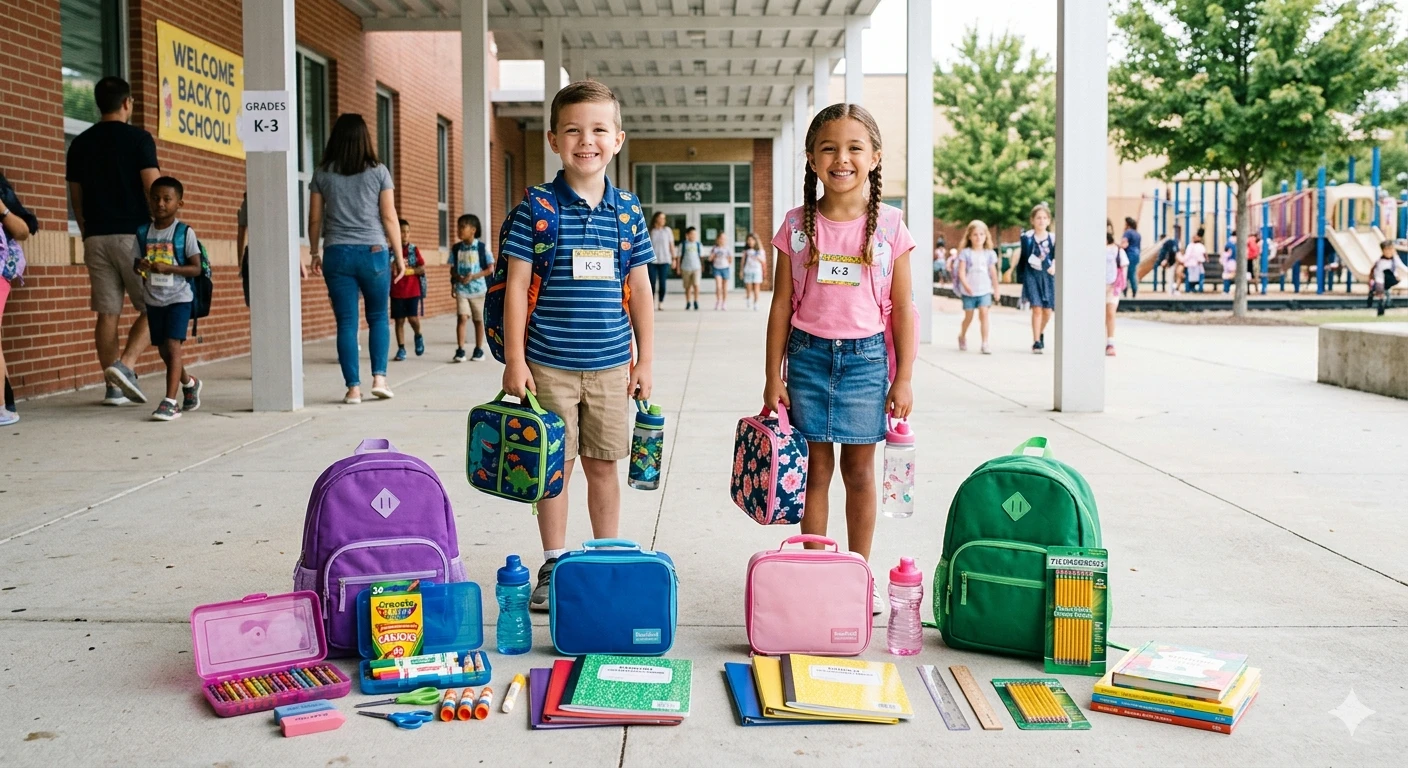
Back-to-school shopping for kindergarten through third grade is a strange thing. You are simultaneously trying to hit a practical supply list, buy stuff that survives a full school year (ambitious), and find a lunchbox your kid will actually be excited to open at noon. That last part matters more than it sounds — a kid who is proud of their gear tends to be a kid who is more excited about school. I’ve seen it in every parenting YouTube channel that covers this topic: the right gear makes the whole first-week-of-school ritual feel like something to look forward to, not just another trip to Target.
This guide covers twelve picks for the kindergarten through third grade range — ages roughly four through nine. We mined channel after channel of back-to-school content from Beautifully Organized, Persia Lou, Cup of Jo, and Bentgo Kids’ own reviewer community to find the gear that came up again and again as actually worth buying. Nothing on this list is just popular-by-algorithm — every pick here was mentioned by at least three independent reviewers as something that genuinely held up.
The 12 picks
1. The lunchbox everyone seems to end up with: Bentgo Kids Bento Lunch Box
If you have spent any time in the back-to-school section of parenting YouTube, you already know Bentgo. Multiple channels — including Bentgo’s own reviewer community and Persia Lou’s annual back-to-school round-ups — have named it as the lunchbox that survives kindergarten intact. The five-compartment tray design means you can fit a main, a fruit, a veggie, a snack, and a treat without any container needing to be opened separately. For a six-year-old learning to manage their own lunch, that matters.
The two things reviewers love most: the latch is strong enough to survive being dropped on a cafeteria floor (something several parents tested by accident), and the compartments are sized in a way that genuinely works for normal kid portions — not too big, not so tiny that a handful of blueberries fills the whole section. Beautifully Organized called out the color options (they add a new batch every year) as a real factor: giving a kid color ownership of their lunchbox produces more excitement than you’d expect.
One honest downside reviewers mentioned: the Bentgo is slightly harder to wash than a single-container box. Dishwasher-safe? Yes. But the tray has five corners where food can sit, and a few reviewers mentioned doing a quick hand-rinse before putting it through the dishwasher. Small trade-off for most families.
Why it made the list: Consistent praise from independent reviewers across multiple channels for durability, usability, and the fact that kids actually use all five sections.
2. The water bottle kids will actually drink from: Hydro Flask Kids Wide Mouth Water Bottle
Water bottle drama is real. Ask any parent who has watched their child come home with a full bottle three days in a row because they “forgot” to drink. The Hydro Flask Kids line came up in multiple reviews — including from Cup of Jo’s back-to-school picks and organizing-parent channels — as the bottle that fixes this problem, mostly because it keeps water cold for a full school day. Warm water is easier to ignore than cold water. That is not a scientific study; it is just consistently what reviewers observed.
The wide-mouth lid on the kids’ version is genuinely easier for smaller hands than the narrow-mouth adult version — several reviewers specifically made this comparison. The chug cap (included in most versions) means no straw to lose and no lid to misplace. And the thing is essentially indestructible: multiple reviewers mentioned dropping it on concrete from heights that should have dented it, with no damage.
The trade-off is the price — Hydro Flask sits at the premium end of kids’ water bottles. But multiple families we saw in review threads reported using the same Hydro Flask Kids bottle from kindergarten through second or third grade without replacing it. The math works out. If it’s still too much, the Nalgene Kids version came up as a runner-up in a few of the same channels — slightly less cold retention, same toughness.
Why it made the list: Cold-retention means kids actually drink, the design survives being thrown in a backpack daily, and reviewers across multiple channels mentioned it lasting more than one school year.
3. The backpack that makes drop-off feel official: Skip Hop Zoo Backpack (Elementary)
This is the older sibling of the toddler Skip Hop we covered in our preschool backpack guide. The elementary size is bigger — fits a standard school folder, a lunch box, a water bottle, and a change of shoes — but keeps the same chunky zipper pull and chest clip that make it parent- and kid-friendly. Beautifully Organized called it out specifically as one of the few character backpacks that has enough main compartment volume to be functional, not just cute.
The character line matters here. A kindergartner who picks their own dinosaur or narwhal or sloth backpack and owns it is meaningfully more excited about school on Day One than a kid handed a generic navy bag. Multiple back-to-school reviewers on YouTube have made this point in various ways: the gear a child feels some ownership over tends to get treated better and get used more.
Reviewers at the older end (second and third grade, ages 7–8) sometimes noted that the Skip Hop characters read a little young for them by that point. If your child is heading into second grade and starting to care about “babyish” vs not, the Fjallraven Kanken (pick #12 below) might be a better long-term call.
Why it made the list: Volume, durability, and the character ownership factor that consistently correlates with kids actually being excited to carry it.
4. The leakproof backup lunchbox: Yumbox Original Leakproof Bento Box
Yumbox does one thing the Bentgo does not: it has a gasket seal that makes it genuinely leakproof. If your child is coming home with wet backpack episodes because a container spilled, or if their school specifically says all lunch containers must be leakproof, the Yumbox is the call. Multiple reviewers at Persia Lou and Cup of Jo specifically mentioned the gasket as the reason they switched from Bentgo.
The trade-off is that the Yumbox is slightly harder for little hands to open — the gasket that makes it leakproof creates real resistance when pulling the lid up. Kindergarten-age reviewers (ages 5–6) mentioned needing to practice. By first grade, it is usually fine. If your child is four, starting with the Bentgo and switching to Yumbox later is a reasonable path.
Why it made the list: The gasket seal is the best leakproofing in this category according to every reviewer who mentioned it.
5. The pencils that actually work in small hands: Ticonderoga My First Pencils
Pencils are not glamorous, but the wrong pencil for a kindergartner is a real frustration multiplier. Ticonderoga’s My First line — the jumbo triangular-grip version — came up in elementary teacher channels and parenting education reviewers as the pencil kindergarten and first-grade teachers most often recommend for at-home practice. The triangular shape discourages the “death grip” that many kids fall into with round pencils, and the eraser is actually functional (a persistent failure point on cheaper pencils).
For second and third graders who are past the grip-development stage, these tip toward overkill. Standard Ticonderoga #2 is fine. But for the K and first-grade set, the My First line is genuinely useful gear.
Why it made the list: Teacher channel endorsement and reviewer consistency around the grip-development benefit for the K–1 age range.
6. The pencil case that stays organized: Zipper Pouch Pencil Case (Yoobi)
Organization channels — especially Beautifully Organized, which does back-to-school prep content every July — consistently recommend a simple zipper pouch over a rigid pencil box for the elementary years. The reason: a zipper pouch fits inside a backpack pocket without creating a lumpy, sharp-edged insert that digs into the bag’s interior. Yoobi’s version comes in a range of colors and prints that kids like to pick themselves.
The honest note: any zipper pouch with a solid zipper works here. The brand matters less than the format. We’re calling out Yoobi specifically because multiple reviewers mentioned the zipper lasting a full school year without getting stuck — a failure point on cheaper pouches.
Why it made the list: Low-cost, practical, and the format (pouch vs box) keeps backpacks organized better than a rigid case.
7. The markers that survive being left uncapped: Crayola Ultra-Clean Washable Markers 20-Count
This is the unglamorous workhorse of every elementary art bag. Crayola’s washable markers came up in every back-to-school supply list we found across parenting channels — not as an exciting recommendation, but as the consistent answer to “what markers should I buy for a five-year-old?” The Ultra-Clean formula washes off skin and most clothing, which is a feature no parent truly appreciates until it saves a good shirt.
The “washable” claim has limits — reviewers noted the ink can linger on fabric if it isn’t treated quickly, so we’d describe it as “washes off skin and most surfaces” rather than “always washes out completely.” For the typical art-at-the-kitchen-table use case, the washability holds up.
Why it made the list: Every back-to-school channel we watched recommended a version of this. The Ultra-Clean formula is the safest bet for the K–2 age range.
8. The item that makes homework time easier: Rocketbook Mini Erasable Notebook
This is the pick for parents of second- and third-graders who are starting to have a homework routine. Rocketbook’s Mini is a small notebook with pages that wipe clean with a damp cloth — you scan a page with the app before wiping, and the scan goes straight to Google Drive, Dropbox, or email. The result: a homework notebook that never runs out of paper, a scanner that lives in a tiny pad, and a built-in forced digitization habit.
Multiple organization-focused parenting channels mentioned the Rocketbook as one of their favorite “things I wish I’d discovered earlier” finds. For a second-grader, the appeal is partly just that it is erasable and feel a little magical. For parents, the organizational benefit is real.
The honest trade-off: this requires a parent to set up the app initially, and it requires an internet connection to sync. Some families have also mentioned the special Rocketbook pen (sold separately) is needed for the best erase results — a detail worth knowing before gifting.
Why it made the list: Strong reviewer enthusiasm from organization channels, and a genuinely novel feature set for the upper end of the K–3 age range.
9. The shoes that survive the first two months: Crocs Classic Clogs for Kids
Shoes are a category we generally do not cover, but Crocs come up in nearly every back-to-school gear discussion we saw for one specific reason: they survive indoor recess, lunch spills, and the puddle that lives outside the school’s side door every fall. Parenting channels — especially practical-parent channels like Mom Smart Not Hard — specifically called them out not as the main shoe, but as the “leave-a-pair-at-school” shoe or the backup for gym days when the main sneakers get wet.
The ventilation holes are a mild issue in cold weather, and multiple reviewers noted keeping a pair of Jibbitz (the charm accessories) as a way to give kids some ownership over a plain shoe. That is not a minor detail — a six-year-old who has customized their Crocs is meaningfully more likely to wear them without protest.
Why it made the list: Durability, washability, and consistent practical praise from reviewer channels that cover daily school life with kids.
10. The stickers that make everything feel like a reward: Lovepop Holographic Sticker Collection
This might be the most low-tech pick on the list, but sticker rewards for kids ages four through eight are genuinely useful gear — and the channels we watched for this age range came back to sticker charts and sticker books repeatedly as one of the most effective low-cost motivational tools for building school routines. Lovepop’s holographic sticker sets came up specifically in a few Cup of Jo–adjacent style-parenting channels as the version kids actually covet, as opposed to the plain smiley-face stickers.
A sticker chart for reading minutes, homework completion, or just “got through the week” is a cheap tool with a measurably positive effect on routine-building for early elementary kids, based on the behavioral research referenced in parenting education channels. We are not overselling stickers. We are just saying: this is worth it and takes 30 seconds to explain to a kid.
Why it made the list: Consistently mentioned in back-to-school organization content as a low-cost, high-impact routine-building tool for K–3.
11. The sleep-routine upgrade that helps school mornings: Trtl Kids Pillow Backpack Insert
This is the wild-card pick. The Trtl Kids pillow-insert comes up on back-to-school channels in a specific context: for kids who have long bus rides (20+ minutes each way), a pillow that fits inside a backpack pocket makes the morning commute measurably more comfortable, and a more comfortable commute produces a slightly less chaotic first hour of school.
Multiple parent reviewers mentioned discovering this pick after their child fell asleep leaning against a cold window on the bus and arriving at school grumpy. The insert is small, washable, and fits in most elementary backpack pockets. For the right family — one with a real bus-commute situation — this is an underrated quality-of-life buy.
For kids who walk to school or get dropped off, skip this and put the money toward a better pencil case.
Why it made the list: Niche but genuinely useful for families with long bus commutes — a category that came up in enough parenting community discussion to earn a spot.
12. The backpack that grows past third grade: Fjallraven Kanken Kids Backpack
The Fjallraven Kanken Kids version is one of the few backpacks that reviewers consistently described as growing with a child from kindergarten through middle school. The boxy shape fits a school folder, a laptop sleeve (for upper elementary), and a lunch box without looking overstuffed. The color options are understated enough to not read as babyish at age 9 or 10.
The honest reason it is last on this list rather than third: it sits at the premium end of kid backpacks, and the straps are unpadded webbing that some kindergartners find uncomfortable for all-day wear. For ages six and up — when the character backpacks start feeling too young but the kid still needs a durable, functional bag — the Kanken is the one to reach for.
Multiple reviewers mentioned the same Kanken Kids bag being used for three or four years without visible wear. For a premium pick, that math is defensible. For a family on a tighter budget, the Skip Hop gets the job done for K–2 for a lot less.
Why it made the list: The only backpack in this category that reviewers consistently described as lasting past third grade without looking worn-out or age-inappropriate.
A few things to think through before you shop
The channels we mined kept returning to a few meta-points about K–3 back-to-school shopping that are worth passing along:
Give your child two choices, not one. A kid who chose between the blue lunchbox and the green lunchbox has ownership over the blue one they ended up with. A kid who was handed a lunchbox has an object. The gear your child had some say in tends to get used better and taken better care of.
The supply list from school supersedes everything. Some K–3 teachers are very specific about what they want (no mechanical pencils, folders must have pockets not just prongs, etc.). Before buying any of the above, read your child’s teacher supply list carefully. Our picks are for the supplemental gear — the lunch box, the backpack, the water bottle — that the supply list does not cover.
Buy the water bottle and backpack before the list; buy the school supplies after. Water bottle and backpack are universal (every school needs them). Pencils, folders, and notebooks are often school-specific. Sequencing your shopping this way means you don’t end up with a stack of the wrong kind of notebooks.
Sources we mined
We synthesized this guide from independent video reviews and back-to-school content from the following channels. We did not personally test these products or send our own kids through the school year with all of them simultaneously.
- Beautifully Organized (YouTube) — back-to-school organization content, lunch box and backpack reviews
- Persia Lou (YouTube) — seasonal back-to-school round-ups and elementary school gear guides
- Cup of Jo (YouTube and site-adjacent) — style-forward parenting content, back-to-school pick lists
- Bentgo Kids (YouTube) — product demos and the reviewer community that grew around the channel
- Mom Smart Not Hard (YouTube) — practical-parent elementary school gear comparisons
A note on how we research
We did not walk these products through a school year ourselves. Our recommendations come from synthesizing multiple independent reviewers’ experiences, aggregated parent ratings, and the organizational and parenting education channels we track. We earn a commission if you buy through our links, at no extra cost to you. We pick the gear we’d genuinely buy for our own kids.
Sources we mined
We synthesized this article from independent reviews on the following channels and sources. We do not control or endorse them — verify safety, age recommendations, and current pricing on Amazon before buying.
- Beautifully Organized — back-to-school organization content, lunch box and backpack reviews
- Persia Lou — seasonal back-to-school round-ups and elementary school gear guides
- Cup of Jo — style-forward parenting content, back-to-school pick lists
- Bentgo Kids (official YouTube) — lunch box demos, real-use parent reviews on the channel
- Mom Smart Not Hard — elementary school gear comparisons and practical-parent takes